Grateful Dead, Lawrence Welk, Marijuana, and Jesus: The Strangest Moment in Television Music
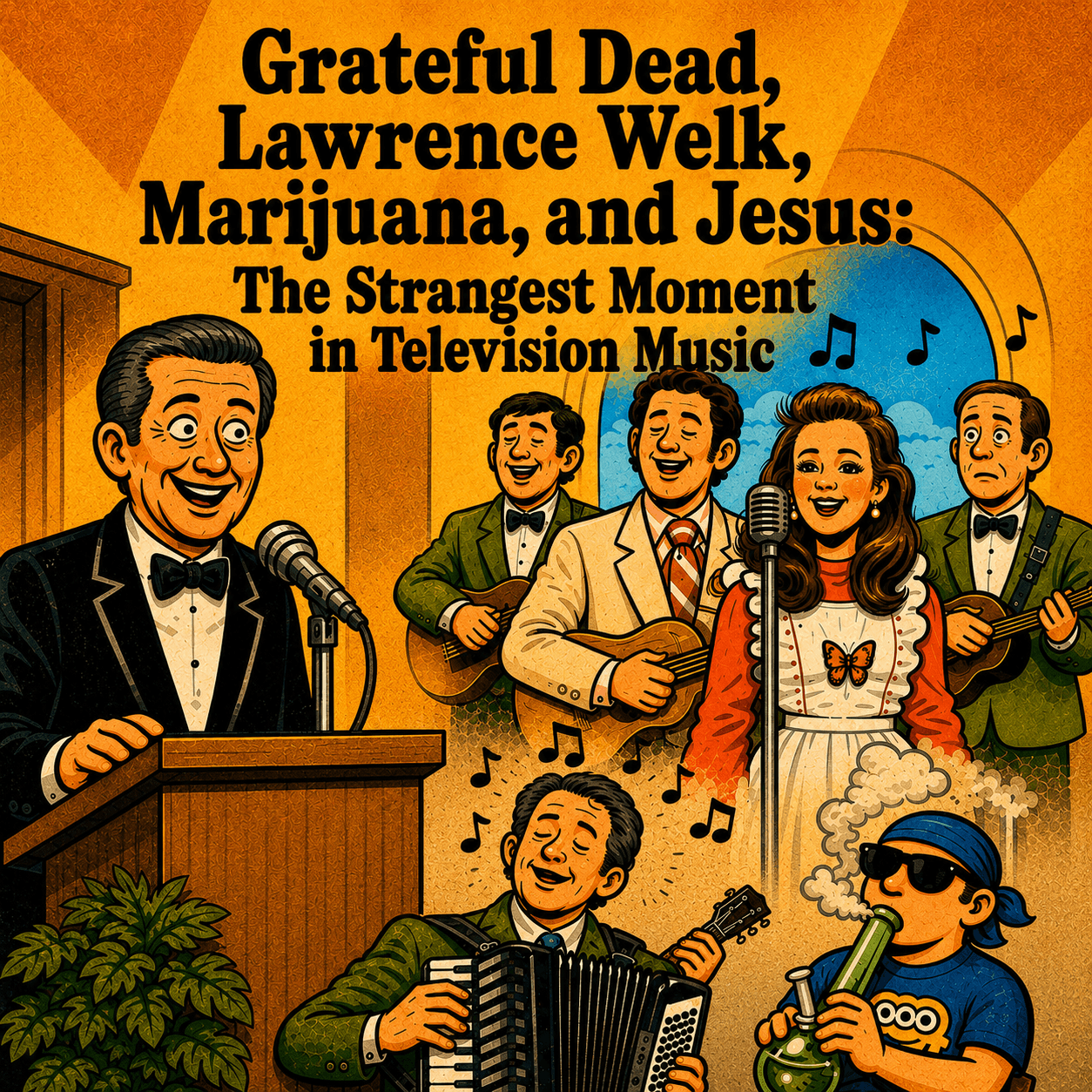
It sounds like a setup to a joke. It isn’t. It’s a real broadcast moment: The Lawrence Welk Show, all smiles and champagne bubbles, earnestly introducing “One Toke Over the Line” as a “modern spiritual.” A song by Brewer & Shipley—openly about marijuana—floats across middle-American living rooms wrapped in innocence, even as its lyrics quietly say the opposite. And then, for a few seconds, something even stranger happens: the music itself seems to wobble, as if the band briefly loses the center—part Grateful Dead drift, part TV-variety precision—before snapping back into place. It’s a tiny glitch, easy to miss unless you’re really listening, but once you hear it, it’s impossible to unhear.
For decades, The Lawrence Welk Show was one of the most controlled environments in American television—ballroom tempos, bright harmonies, and a kind of practiced cheerfulness that never slipped. Which makes the opening line land with a strange kind of force: “One toke over the line, sweet Jesus.” It’s hard to think of a more unlikely pairing for that stage—marijuana slang and a direct invocation of Jesus, side by side, sung without a hint of irony. A song by Brewer & Shipley, already circulating in a very different context, is introduced as a “modern spiritual” and delivered as if it belongs there. Nothing in the room suggests otherwise.
Even the introduction has a moment that feels oddly out of place. Lawrence Welk doesn’t just clear his throat—he seems to struggle with it, pausing, catching his breath, struggling to get the words out. It goes on just long enough to register. In any other context it would pass unnoticed, just a host working through a rough moment. But here, given the song he’s introducing, it’s hard not to hear it differently—uncannily like someone recovering from a bong hit. It’s almost certainly coincidence. But once you notice it, it’s difficult not to.
If you look it up, the clip is easy to find—titled “One Toke Over The Line - Lawrence Welk - WTF! (1971)”—and the “Grateful Dead” moment comes at about 1:36. It passes quickly. Most people won’t notice it at all the first time through. The performance just seems to loosen slightly, as if the band is relaxing into the groove. But if you’re listening closely—or better yet, playing along—you start to hear something else: briefly, the center isn’t quite there.
Briefly, it sounds like the band isn’t entirely in the same place. Not dramatically—nothing falls apart—but the center feels unsettled, as if two different harmonic ideas seem to be happening at once. It’s the kind of moment that’s easy to gloss over unless you’re listening for it. But if you are, it has a distinct quality: not looseness exactly, not hip chromaticism, but a brief sense that no one is completely sure where “one” is, rhythmically or harmonically.
If you sit down at a keyboard and try to follow it in real time, the effect becomes much clearer. You settle into C, everything lines up, and then—suddenly—there are notes that don’t belong there. A C♯ shows up against a C center. A moment later, an F♯ pushes against what should be a straightforward F. Not as passing color, not as phrasing, but as real, sustained tones that don’t agree with the harmony you’re playing. For a beat or two, the ground shifts under your hands. Then it’s gone.
It happens right as the arrangement starts to open up. The groove loosens, and for the first time an electric guitar begins tracing quiet lead lines behind the vocals, introducing a new voice into a moment that’s already in motion. For a few seconds, it almost sounds like someone—maybe the keys—decides it’s time for that classic half-step lift, the kind of upward key change that shows up in so many arrangements, and, on autopilot, makes the move regardless of what the chart reads. The electric guitar seems to follow that shift, at least for a moment. There’s a brief stretch of real confusion caught on tape—two directions at once, not quite lining up, as if more than one player is hearing the same thing while the rest of the band hasn’t moved at all. Then it collapses. The band tightens immediately, the harmony snaps back into place, and the groove settles as if nothing happened. The singers never flinch. They stay right on the line, centered and steady, carrying the melody straight through the moment. If there’s any awareness of it on stage, it doesn’t show.
It also leaves open a quieter question that never quite resolves: who in the room understood what they were playing? The song wasn’t obscure. The phrase wasn’t invented for the show. Somewhere between the band, the singers, and the people who put it on air, someone must have recognized it. Or maybe not. The performance doesn’t offer any clues. No one reacts. No one breaks. Everything proceeds as if it were exactly what they said it was.
And that’s where it stays. The band locks back in, the arrangement resolves, and the number ends the way it began—polished, smiling, intact.
Long before Cheech and Chong, before Snoop Dogg, there was Lawrence Welk—gently introducing something very close to 420 culture to middle America.