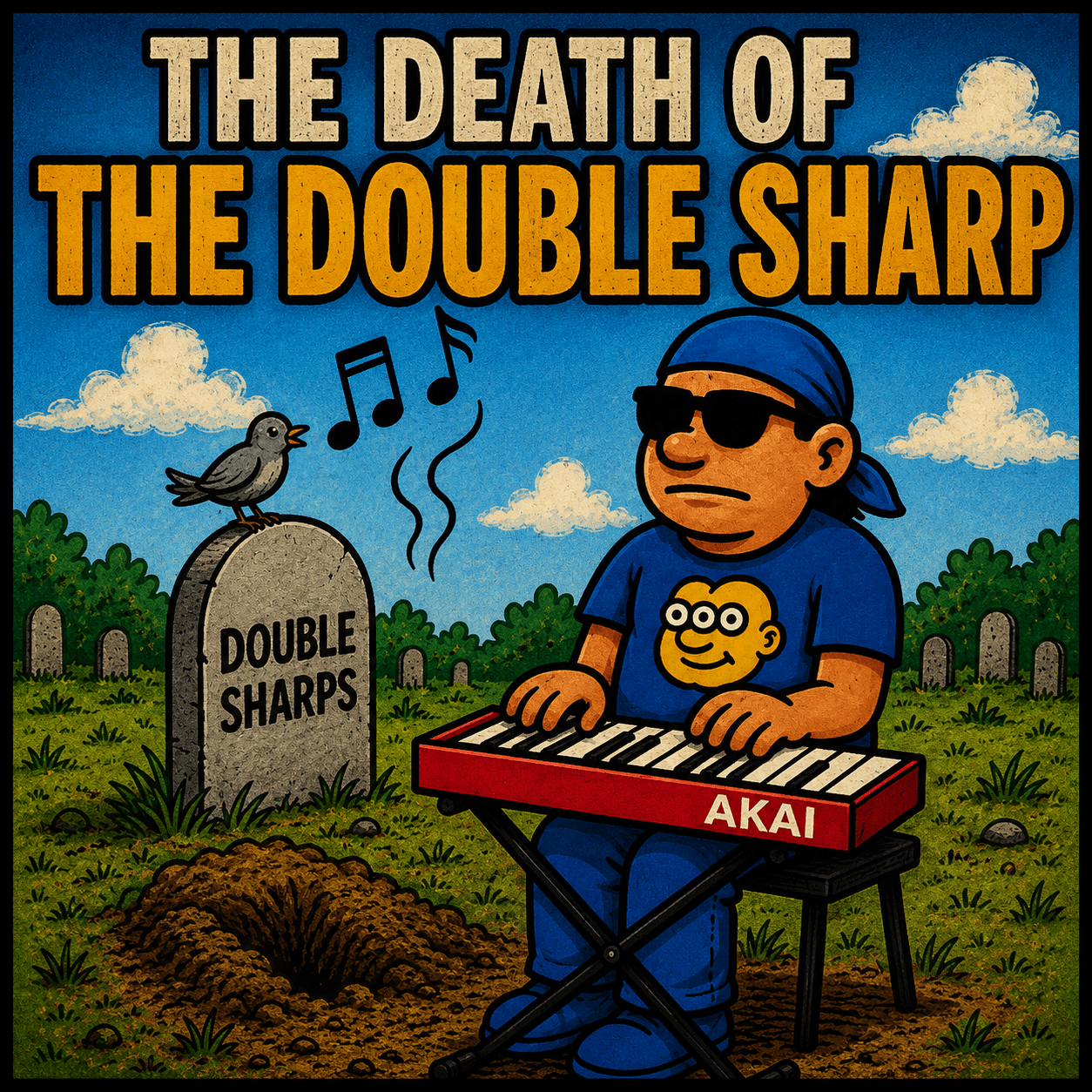
The Death of the Double Sharp
Song: Taps
If you really want to upset someone who just spent tens of thousands of dollars on a music degree, tell them you think double sharps are completely useless.
Because outside a narrow slice of classical music, they are. Double sharps change the name on the page, not the sound you hear.
And once you step outside that tradition, the entire system collapses. Most of the world’s music has no use for double sharps or the rules that keep them alive.
Here’s the split: the tiny corner of music where this system still matters, and the much larger world that left it behind.
Genres Where Double-Sharp Thinking Actually Matters
Only a few styles keep the full classical notation system because it supports their voice-leading rules, harmonic formulas, or academic analysis:
Baroque / Classical / Romantic concert music (Bach → Brahms → Wagner) Early 20th-century tonal concert music (Ravel, early Stravinsky) Traditional Western choral & church music with strict part-writing Music theory pedagogy (counterpoint, harmony classes, conservatory analysis) Film scores & Broadway pre-1960 modeled on late-Romantic symphonic writing Here, the system still makes sense because the whole compositional language grew out of the same soil: diatonic scales, modulations, functional harmony, stacked thirds.
Genres With No Real Use for Double Sharps
Everywhere else, music abandoned the strict system and just wrote what was easiest to read — or skipped notation entirely:
Jazz (most styles) Blues Rock & Pop Folk & Country Hip Hop / Rap R&B / Soul / Neo Soul Funk Electronic & Dance music (EDM, House, Techno, etc.) Latin & Afro-Latin styles: Salsa, Bachata, Reggaeton, Tango Caribbean music: Reggae, Calypso, Soca Afrobeat World & Traditional: Indian Classical (Hindustani, Carnatic) Middle Eastern (Maqam, Arabic traditions) African Traditional Native American East Asian Traditional (Chinese, Japanese, Korean) Celtic Flamenco Balkan folk Christian & Gospel (modern styles) Contemporary musical theater (post-1960) Children’s music Avant-garde & experimental World fusion / cross-genre projects These styles use whatever harmonic or modal language suits them, without needing the strict notation rules of classical theory. Some have deep systems of their own — jazz harmony, Indian ragas, gospel voicings — but they don’t gain anything from double sharps.
The Jazz Wild Card
Jazz sits in a strange middle ground.
The early jazz tradition was built on live performance and ear training, not on formal notation or theory classes. Nobody in bebop or swing stopped to spell a D as C##. Clarity mattered more than correctness.
But modern jazz education grew out of conservatory culture. On paper, students might see double sharps in arranging or analysis classes because that’s how their professors learned to notate.
And here’s the split: in theory class, a double sharp might make sense because it shows how a note relates to the original scale degree. But on gigs, in charts, or when arranging for real players, clarity wins. Even in big band scores, arrangers rewrite accidentals in the simplest possible way so the notes are quick to read at sight, and they change the key signature when the music modulates instead of leaving players to fight through a forest of extra sharps and flats.
Jazz schools may preserve the knowledge, but the practice still leaves double sharps on the shelf.
The Bottom Line
Double sharps survive because classical music built formulas on top of them. Outside that narrow tradition, the system offers no advantage.
#MusicTheory #MusicianLife #PianoHumor #MusicEducation #LearnMusic